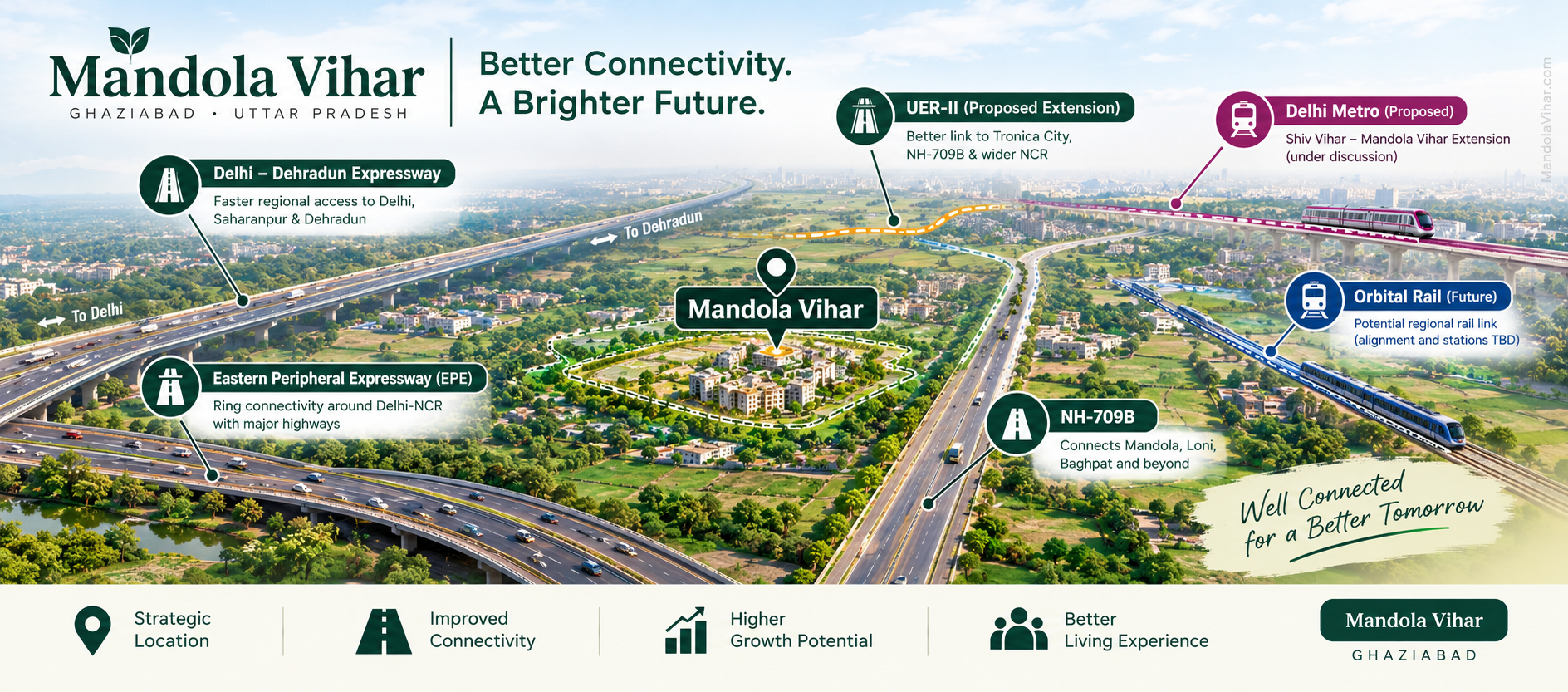
Mandola Vihar, Ghaziabad, Uttar Pradesh, is located in a strategically important part of the Delhi-NCR region. Its connectivity story is no longer limited to the roads serving the immediate locality. The wider area is connected to major highway corridors, including the Delhi–Dehradun Expressway, Eastern Peripheral Expressway (EPE) and NH-709B, while proposed road and public transport projects could further strengthen regional accessibility.
For homebuyers, investors and businesses, the important question is not simply how many infrastructure projects are announced around Mandola Vihar. It is how these projects connect with one another, which facilities are already operational, and which developments are still awaiting approvals or construction.
This guide examines the wider connectivity network around Mandola Vihar, the potential benefits for the locality and the key developments worth monitoring in 2026.
1. Delhi–Dehradun Expressway: A Major Connectivity Advantage
The Delhi–Dehradun Expressway, also known as the Delhi–Saharanpur–Dehradun Economic Corridor, is one of the most significant infrastructure projects in the region.
The approximately 210-km corridor connects Delhi with Baghpat, Baraut, Shamli, Saharanpur and Dehradun. Its Delhi-side alignment passes through the Mandola area before connecting towards Khekra and the wider highway network.
The expressway was inaugurated in April 2026, marking a major milestone for regional road connectivity.
Why it matters for Mandola Vihar
Improved regional access: The corridor strengthens road connectivity between Delhi, western Uttar Pradesh and Uttarakhand.
Access to a major transport corridor: The surrounding Mandola–Khekra region gains importance within the wider expressway network.
Potential commercial activity: Better regional movement can support businesses, logistics and services in suitable locations.
Long-term residential appeal: Improved accessibility may be a positive factor for people evaluating residential locations in the region.
However, there is an important distinction between an operational expressway and the availability of a convenient entry or exit ramp. Reporting in April 2026 highlighted a continuing land dispute affecting a planned ramp near Mandola. Therefore, buyers should verify the currently usable access points and local approach roads before estimating their actual travel time.
The Eastern Peripheral Expressway is an established, approximately 135-km access-controlled corridor connecting Kundli in the north with Palwal in the south through the wider NCR region.
It was developed in part to divert through-traffic away from Delhi and improve movement between destinations around the capital.
For Mandola Vihar, the EPE is relevant because it forms part of the wider highway network accessible from the surrounding Ghaziabad–Baghpat region.
How EPE can benefit the surrounding area
Connects the wider region with major highways without requiring every journey to pass through central Delhi.
Supports movement towards different parts of the NCR and adjoining industrial and commercial areas.
Complements the Delhi–Dehradun Expressway and other regional road corridors.
Improves the strategic importance of locations that have convenient access to suitable highway interchanges.
The practical benefit for an individual resident depends on the actual route, interchange used, traffic conditions and distance from the property to the relevant access road.
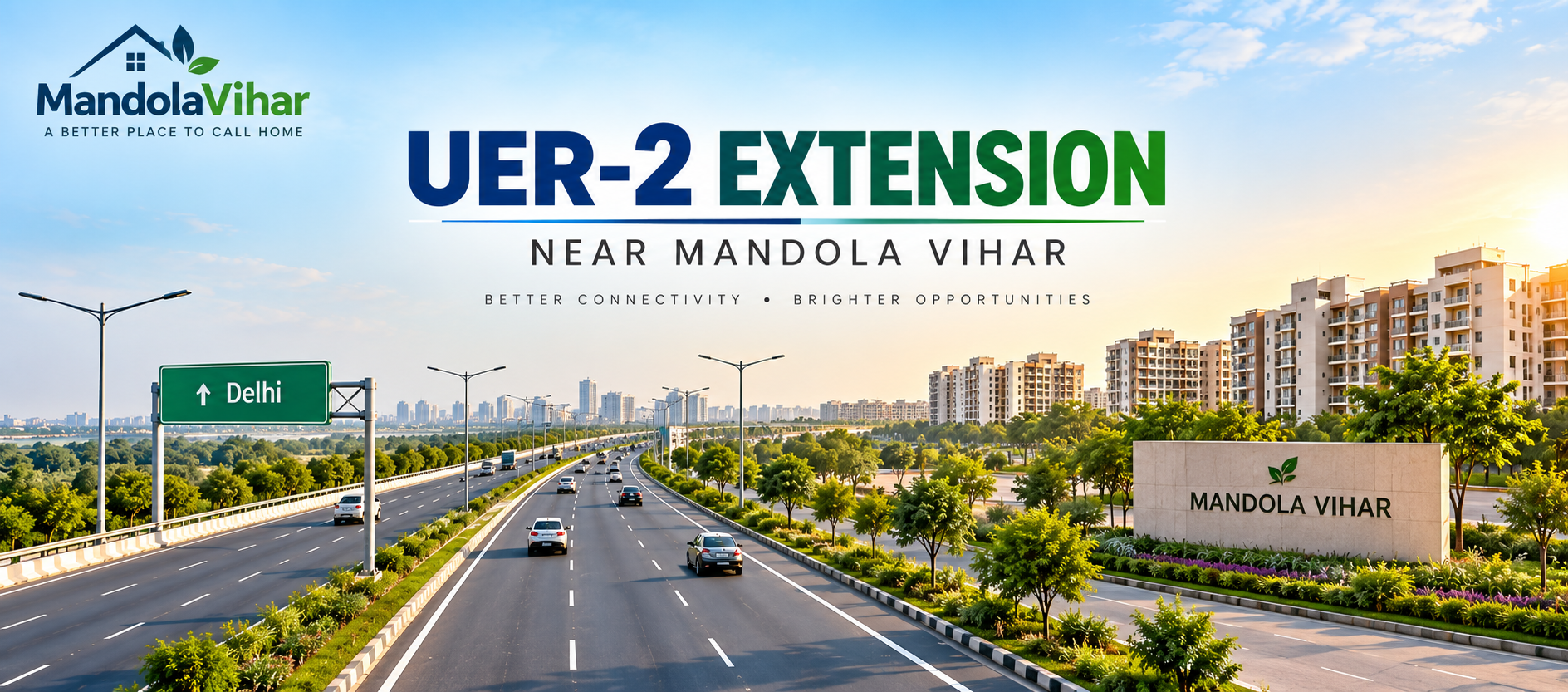
Urban Extension Road-II (UER-II) is an important component of Delhi’s wider road network. The proposed eastern extension towards Tronica City and NH-709B is particularly relevant to the Mandola Vihar region.
National Capital Region Planning Board records refer to the Alipur–Tronica City connection, while NHAI has undertaken consultancy work relating to preparation of a Detailed Project Report (DPR) for the eastern extension.
The project is significant because it could create another connection between the Delhi-side road network and the Tronica City–NH-709B corridor.
What could change if the connection is developed?
It could provide an additional route between parts of Delhi and eastern Ghaziabad.
It could improve connections between existing and proposed regional road corridors.
It could offer alternative travel routes for some journeys, depending on the final alignment and access points.
It could increase the importance of well-connected locations across the wider Trans Delhi Signature City and Mandola region.
At present, the proposed eastern connection should not be described as a fully operational road. Its final alignment, implementation and opening timeline must be established through official project updates.
National Highway 709B is another important part of the regional connectivity picture. It links the Delhi side with Loni, the Mandola area and destinations towards Baghpat and beyond.
The highway corridor serves a different function from a fully access-controlled expressway. It also supports connections to existing settlements, local roads and commercial areas along its route.
For Mandola Vihar, this distinction matters because residents need both long-distance road access and practical connections to nearby markets, workplaces, schools and public services.
The proposed UER-II eastern extension towards Tronica City and NH-709B could further strengthen the relationship between this highway and Delhi’s wider road network if it is implemented as planned.
5. Delhi Metro: The Proposed Shiv Vihar–Mandola Vihar Connection
Metro connectivity is another development attracting interest among residents and property seekers.
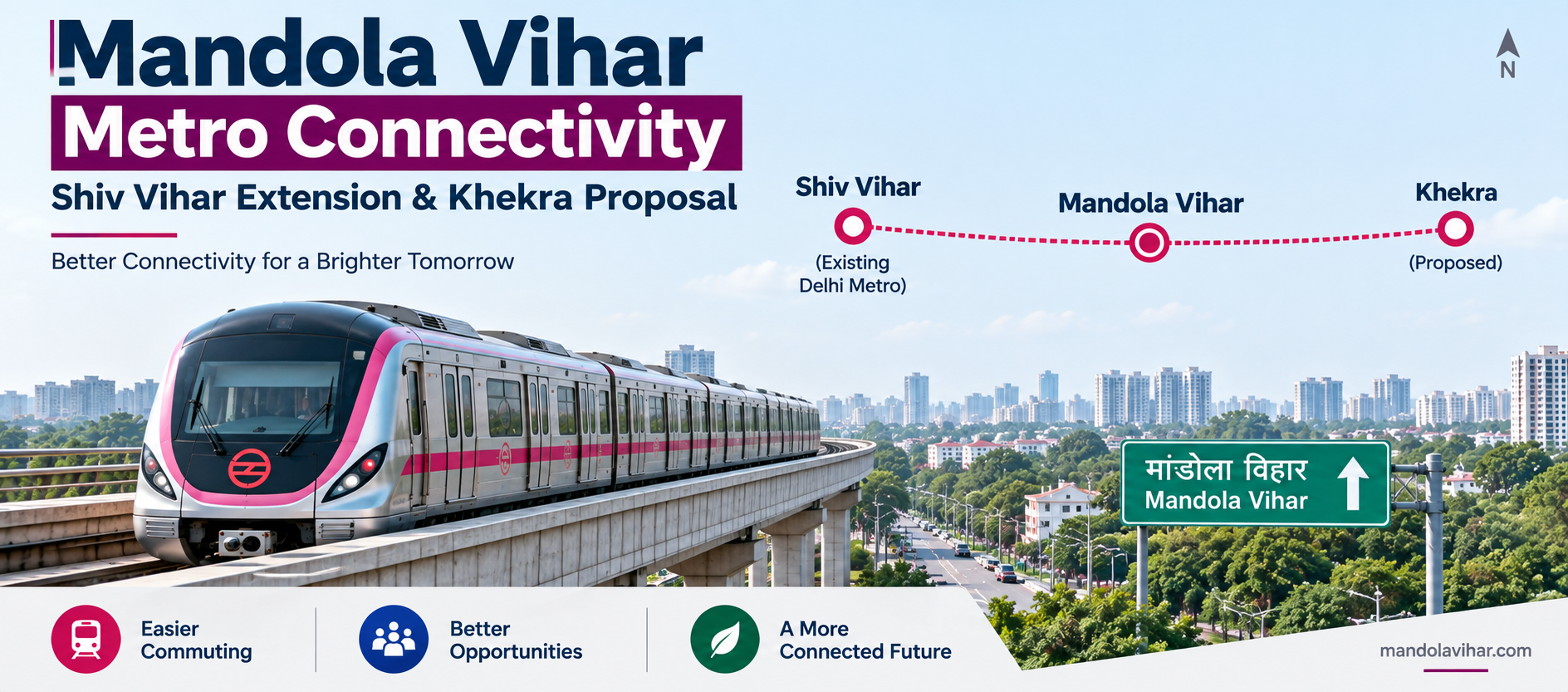
A proposed extension of the Delhi Metro Pink Line from Shiv Vihar towards Mandola Vihar has been discussed, with a reported joint committee studying the possibility of an extension and related technical considerations.
The proposal could be important because metro access can improve daily commuting options and reduce dependence on private vehicles for suitable journeys.
However, the proposed extension must be distinguished from an approved, funded and operational metro line. The final route, station locations, project approvals and completion schedule should be confirmed through official announcements.
A separate proposal or demand for metro connectivity towards Khekra should also not be confused with an approved extension to Mandola Vihar.
6. Namo Bharat and Regional Rapid Transit: A Wider NCR Perspective
The Delhi–Ghaziabad–Meerut Namo Bharat corridor became fully operational in February 2026. This is an important development for regional public transport across the NCR.
The wider regional transport network is also being considered for expansion. In 2026, proposals for additional Namo Bharat corridors and their Detailed Project Reports have been reported, including a proposed Ghaziabad–Noida International Airport connection.
For Mandola Vihar, these developments are relevant as part of the wider evolution of NCR transport. However, the existing Delhi–Ghaziabad–Meerut corridor should not be presented as a direct metro or Namo Bharat connection to Mandola Vihar.
The actual benefit for residents will depend on station locations, interchange arrangements, road access and the availability of reliable first- and last-mile transport.
Regional and orbital rail concepts are relevant to the long-term transport planning of a large metropolitan region such as the NCR. Such networks can potentially connect multiple urban centres without requiring every journey to pass through central Delhi.
For Mandola Vihar, an orbital rail connection would be meaningful if an officially approved alignment, station or interchange were planned within practical travelling distance of the locality.
However, the available information reviewed for this article does not establish a confirmed, approved orbital rail station or alignment serving Mandola Vihar directly.
For that reason, an orbital rail corridor should currently be treated as a longer-term planning consideration rather than an assured connectivity benefit. Any future claim about its route, station locations or implementation schedule should be based on an official NCRPB, railway or government project document.
8. How These Projects Could Work Together
The wider connectivity picture is more important than any single project in isolation.
Infrastructure
Role in the regional network
Relevance to Mandola Vihar
Delhi–Dehradun Expressway
Long-distance, access-controlled road travel
Major corridor near the Mandola–Khekra region; actual ramp access matters
Eastern Peripheral Expressway
Movement around Delhi-NCR
Wider regional highway access
NH-709B
Highway and settlement connectivity
Connects the locality and surrounding areas with regional destinations
UER-II eastern extension
Proposed additional road connection
Could strengthen the Delhi–Tronica City–NH-709B link
Delhi Metro extension
Proposed urban rapid transit
Potential future daily commuting option
Namo Bharat network
Regional rapid transit
Wider NCR benefit; no direct Mandola station established here
Orbital rail concept
Potential regional rail connectivity
Requires verified alignment and station details before local benefits can be assessed
Together, these corridors illustrate why Mandola Vihar’s connectivity should be evaluated as part of a larger regional network rather than by looking at a single road or proposed station.
9. What Does Better Connectivity Mean for Property Buyers?
Infrastructure can influence a property’s appeal, but the effect is neither automatic nor uniform.
For a buyer considering a plot, house or commercial property in Mandola Vihar, the following factors are particularly important.
Actual travel time
Check the real driving route from the specific property to the required highway entry, metro station or workplace. A nearby expressway does not necessarily mean a nearby usable entry point.
Local road quality
Internal roads, junctions, street lighting, drainage, pedestrian access and traffic management can have a more immediate effect on everyday convenience than a distant infrastructure proposal.
Access to essential services
Schools, healthcare, markets, public transport and workplaces should be assessed alongside highway connectivity.
Project status
Distinguish between operational facilities, projects under construction, approved projects and proposals that remain at the planning or DPR stage.
Property documentation and pricing
Do not pay a premium solely because of a proposed expressway extension, metro station or rail corridor. Verify the property’s title, land-use status, applicable approvals, exact location and prevailing market prices independently.
10. Connectivity Outlook for Mandola Vihar in 2026 and Beyond
Mandola Vihar’s regional connectivity story includes an inaugurated Delhi–Dehradun Expressway, the established EPE and NH-709B highway network, a proposed UER-II eastern connection and possible future public transport improvements.
The key opportunity lies in how effectively these facilities connect with local roads and everyday destinations. The key uncertainty lies in the delivery of proposed infrastructure, the final location of access points and the approval of future rail or metro links.
For residents and property seekers, the most useful approach is to follow verified project updates and assess connectivity from the exact location of a property rather than relying on broad claims about nearby infrastructure.
As official announcements emerge, MandolaVihar.com will continue tracking developments affecting road access, public transport and the long-term growth of the area.
Disclaimer: Infrastructure status and proposals may change. This article is an informational overview, not a guarantee of future construction, property appreciation or travel times. Readers should verify project status with the relevant government authority before making a property or investment decision.
Metro connectivity is an important part of Mandola Vihar’s future development. At present, two separate developments are drawing attention: the proposed extension of the Delhi Metro…
Mandola Vihar is located in a fast-developing part of Ghaziabad. The area is seeing growing interest in residential development and regional connectivity. One of the infrastructure…